Pages

Monday, December 31, 2012

Digital Footprint: The Big Cleanup

Image: http://wakeup-world.com
One small step for man; one great big leap into oblivion for a digital junkie. Yet the time finally arrived when I simply had to clean up my digital footprint. Yes. I've done it. I have deleted all the online accounts I no longer use, and updated the rest. With a virtual history like mine I can assure you that is no mean feat. 

At this stage I am still not entirely convinced that I actually exist if I no longer fill the entire first page of a Google search for my name. That's all right, though: I have a strange sense of being purified and reborn. Not to mention a little more up to date. The drawback of old those old online accounts was not so much that they had become out of date as that many of them no longer reflected my interests or views, and worse yet, they left just a little bit more information about me out there than I would like to share with the whole wide world and its evil cousins. 

While there is no doubt that many online services can make life easier, better or simply more fun, there is a sinister side to sharing personal data indiscriminately. Perhaps How to Ditch Big Brother and Disappear Forever is taking things a bit far, but periodocally re-evaluating what we share online is probably not a bad idea. In my case it was a pre-New Year's resolution and something of a personal revolution. And while my virtual identity has taken a bit of a blow in the process, real life is the better for it. 

Thinking of a digital footprint cleanup? While you might want to erase your digital footprint completely, most normal people who are not running from the law will benefit from simply deleting unused old accounts, adjusting privacy settings on accounts they wish to maintain, and reconsidering who really belongs in their social networks. 

Here's to virtual rejuvenation!

Thursday, December 13, 2012

Learning Miracles

It was this night, exactly one year ago, that miracles irrevocably became a cornerstone of my existence. When my brother Max sustained a severe brain injury in a car accident on 13 December 2011, it became perfectly clear that the only viable option was the impossible. Since then my family has operated in a delicate web of what can only be called miracles. If there is anything worth learning, this must be it. 

Image: Max & Me, December 2012 (mtcleroux)
A brain injury can have any of a range of effects of varying severity, and it can take a long time to determine their nature and scope. In Max's case the wait was long and uncertain. It was almost four months before he showed clear signs of awareness and comprehension. Complications, many of them caused by hospital "superbugs", side effects of medical treatment and inactivity, left his life hanging in the balance long after he regained consciousness. Forget recovery: for a long time survival alone was nothing short of a miracle. And what would his quality of life be after all this? 

While the effects of such a massive injury are extensive and do take time to address, his condition today, one year after the accident, is awe-inspiring. Seven months after being sent home by doctors who said there was no longer anything they could do for him, Max is undeniably back on the map. Today he woke up after a full night's natural sleep to enjoy a playful and complex two-way conversation over a morning drink. He demolished small, nutritious meals every few hours, carefully chewing and swallowing without incident. He frequently requested what he needed to be more comfortable or satisfied. He graciously received guests and made conversation with them, referring to shared knowledge and long-standing private jokes. And, yes, he made his thumbprint to certify a document, because he has not yet regained full control of his arms, legs and neck. That is a matter of time. 

Because when you deal in miracles you soon realise that they are not always beyond understanding. Most certainly there are things over which no human can exercise control, and it is justified to marvel when they go right. Yet the scope of what we can control should not be underestimated. How many seemingly insurmountable obstacles can be scaled with persistence in even the smallest steps? Even the tiniest actions add up phenomenally when they are persistently taken: the results seem nothing short of miraculous. 

In this case, above all, an atmosphere of unconditional love has meant that everything is all right, every moment, no matter what. The only expectation is to fully explore potential, and this expectation applies not only to Max but also to everyone in his support team: the family, care workers, the army of healing practitioners with a battery of techniques ranging from the conventional to the extreme fringe - and even the many administrators guiding us through the red tape surrounding all this. Everybody plays their part, and it all adds up.

I am in no position to deny that miracles that transcend human understanding are possible: like a presidential spokesperson I can neither confirm or deny their existence. What I do have evidence of is that when small actions and small kindnesses add up, the results are nothing short of miraculous.

To all those who have taken those actions - big and small - and shared those kindnesses, I offer my sincerest acknowledgement. You have participated in a miracle. More than that: you have exposed the formula for miracles that can be duplicated in any situation. What we can accomplish together is mind-boggling. Miracles? We should do this more often.

And to Max? You are perfect. Always have been, always will be. With a brain re-wired and a life re-invented, perhaps more so than ever. 

Sunday, November 25, 2012

ZOOM

I recently came across an educational video from the 1970s that illustrates the relative scale of objects in the universe, from the "innerspace" between sub-atomic particles to the vastness of outer space. Yes, the production may seem a bit dated and even cheesy, but the point was really driven home. It also brought to my awareness the value of "zooming" in and out cognitively. But first, the video.


It so happened that I saw this just after a short but much-needed holiday, where for the first time in eighteen months I was able to step out of the urgency of work and family matters to "zoom out" to a bigger picture. As it turns out, the week away may have been one of the most productive in all that time! There is the wonderful idiom of not seeing the forest for the trees, and stepping away to see the forest has given me a much better perspective on the trees to which I have had my nose pressed for so long. Not only has this given new life to those projects, but it has also lifted my mood tremendously. 

Another discovery (or re-discovery) that drove the point home was dabbling in Prezi, the "zooming" presentation software that offers a welcome non-linear alternative to "death by PowerPoint". Prezis offer the alternative to zoom into elements, which can be hidden indistinguishably inside images and zoomed into... a bit hard to describe, but this example is well worth seeing. After watching a number of jaw-dropping Prezis and trying it out myself (with less stellar results), this idea of zooming in and out from the big picture to infinite complexity really stuck with me. 

As if this weren't enough, I then stumbled (or re-stumbled) upon the beguiling RSA Animate series, which uses an animation style known as scribing - representing the spoken word in a highly visual way. The end of each RSA animation zooms out from the intricate network of illustrated ideas to the "big picture", which includes the entire opus. This is the kind of thing that makes any chaos theory buff tingle. 

The point of all this is that human beings (especially the one sitting in my seat) benefit from using their faculty of zooming in and out to the fullest. Especially in the world of work, and perhaps even more so of study and scholarship, results can be enriched infinitely by "zooming out" to other activities, other disciplines and even total randomness (known in a more poetic bygone era as serendipity). In fact, an influential analysis of creativity (The Art of Thought by Graham Wallas, 1926) suggests that an "incubation period" of stepping away from a project may indeed be the most productive step after a certain amount of preparation, since it leads to "illumination". 

Zooming out is not a waste time: it may the the time best spent.  

Sunday, October 28, 2012

Music!

Image: Harlequin and Pierrot by Andre Derain (1924)


We are the music makers,
And we are the dreamers of dreams,
Wandering by lone sea-breakers
And sitting by desolate streams;—
World-losers and world-forsakers,
On whom the pale moon gleams:
Yet we are the movers and shakers
Of the world for ever, it seems.

-Arthur O'Shaughnessy, Ode (1874)


As the buoyant strains of Arabic pop started to gently unravel my Sunday blues, the wonderful book The Tao of Music by Dr John M. Ortiz came to my mind. When reading the book, which has been one of my treasures, I remember being struck by how prolific and versatile the author was. Aside from his contribution to psychology, he was also an accomplished musician and martial artist. Curious to find out about his more recent work, I tracked down his Institute of Applied Psychomusicology website. Here I was once again moved to find evidence of the vibrant and passionate work Dr Ortiz had done during a lifetime that was resonant and harmonious in every sense of the word. Ideas from The Tao of Music have often echoed in my  endeavours, and I am grateful to have shared in a few lines from this great man's song. 

Ideas from The Tao of Music
Because concepts from the book have been so helpful to me in work and life at large, I am listing a few here with a brief description. The Tao of Music is a treasure trove of further ideas, though, and well worth a complete reading. 

Music for Mood: The book suggests a spectrum of ways to use music for directing moods. This is applied to more serious clinical cases, but is equally valid for everyday emotional obstacles (like getting through Sunday evening/Monday morning, in my case!). See my earlier post on sourcing music for mood online for more ideas. 
Music for Training: Working from a psychological perspective, many of the training objectives in the book involve personal traits, such as overcoming fears or "training" to take on problematic situations successfully. Incidentally, since an important part of my current project involves training groups of people, I have become acutely aware of how helpful music can be in this respect as well. 
Music for Timing: An excellent trick from the book is to use music for timing. The duration of a piece of music can be used as a natural timing device, whether it is for an exercise regimen or household chores. I once attended an outstanding training course where the dramatic, 70-second Also Sprach Zarathustra by Richard Strauss was played to bring trainees back from breaks. 100% effective!
Music for Concentration: Musical awareness has often been alleged to correlate with concentration and thinking skills. Anyone can capitalize on this by selecting music that supports concentration during intensive thinking tasks. My own experience with this is that when I have academic writing or reading to do, I put on Baroque music (and a burner of peppermint essential oil), and emerge two hours later having moved mountains. The force of habit certainly plays a part, but the music is definitely an essential ingredient. 
Music for Escape: Perhaps not the way it is phrased in the book, but every music lover knows that sound holds a secret door to anywhere and anywhen. My favourite suggestion from the book is called "The Magic Nightclub", and it involves lining up your most-loved energizing music, unplugging the phone and setting up a space where you can dance your heart out. (At least, that's the way I do it, though I might have adapted it a bit....)
Musical Menus: The book offers suggested "menus" of music for different purposes, including tracks, artists, albums and the playing time for each recording. 

21st Century Twists
The Tao of Music contains ideas of lasting value. However, it was published in the 1990s, just shy of many of the technological developments that have revolutionized music in recent years. Seen from a contemporary angle, there are many new possibilities: playlists, public domain music, streaming radio, music discovery, recording your own music with free software, remixing existing music... I shan't say more than that for now, but technology has added countless variations to a theme that sounds wonderful already.

Curious? Get The Tao of Music from The Book Depository and enjoy free delivery on all books. 

Thursday, September 20, 2012

ICAL and Mobilcase 2012 Conference


I love returning from a professional development of any stripe with new inspiration. That said, in a publish-or-perish environment I have been known to return from conferences in the throes of an existential crisis: the pressure to produce does not always result in the most meaningful product, and as manufacturers like to say, "results may vary". The International Conference on Active Learning (ICAL), hosted in tandem with the International Conference on Mobile Learning (Mobilearn) at Universiti Teknikal Malaysia the past few days was a pleasant surprise. 

Although the event was a first for the organizers, it stood out for its remarkably friendly atmosphere and kind, helpful organizing staff. The few teething problems that are not at all unusual for a first event of this magnitude were swiftly and efficiently addressed. More importantly though, I heard repeatedly that participants and presenters alike felt they were learning. Speaking for myself, I was quite pleased to make a few new discoveries and, I must admit, get my groove back after being in a bit of a rut for a while - an occupational hazard of working on a very focused, demanding project.

Scheduling made it possible to attend all the keynote presentations, while there were parallel sessions for the other presentations and workshops. As luck would have it, the parallel sessions I attended were enriching and uplifting. My rather rough notes are available here, but in this post I will just include a very brief summary and links to keynote presenters' work where relevant. (These people all have a batallion of titles, which accounts for the length of this post: for once I am not solely to blame ;) ). 

The first keynote speaker rather blew me away. Associate Professor Dr. Khairiya Mohd Yusof of Universiti Teknologi Malaysia tears down a multitude of preconceptions, not only with her prolific work that speaks of true dedication and razor-sharp intelligence, but also by being living proof of what Malaysian women can accomplish in science. In an unassuming but accomplished presentation she shared a promising model for active learning in engineering courses, as well as a wealth of further insights. 

Next, Prof. Dr. Mohamed Amin Embi introduced online and mobile tools for encouraging active learning. The use of these tools was interwoven into the presentation, giving it a hands-on feel and letting everyone walk the talk. He also elaborated further on Web 2.0 tools (defined here in my own earlier work) hosted on his internationally popular website, jitzu.ukm.my/web20/, which gives a brief introduction to an array of tools. Although this is a field where much of my own early research was focused, I was pleased to find how much the field has been moving forward, and discovered a few new gems. 

Prof. Wong Lung Hsiang of Nanyang Technological University, Singapore and Learning Sciences Lab had some fascinating developments to report on in what he terms Seamless Learning, where learning is interwoven into different aspects of life, including but not limited to mobile devices. In fact, his research has specifically focused on engaging learners through physical and outdoor activity, and also involving entire families in the learning process. This really struck me as significant as the mobile learning juggernaut gains speed, and is one of the concepts that made a particular impact on me. I also agreed with Prof. Wong that a process of enculturation is required as learners become more autonomous, but also increase their interaction with others, while fully exploiting the learning experience independently as well as with guidance. 

A final treat was Prof. Dame Dr. Wendy Hall, of Southampton University, UK and the Web Science Trust. Another advocate and shining example of women in science, her work on hypertext has its origins even prior to the World Wide Web as we know it. Her presentation gave a concise overview of the history of hypertext, the philosophies underlying "the social machine", as conceived by Sir Tim Berners-Lee, "father" of the Web (and yet another holder of a title) in his seminal work Weaving the Web, and the way forward. This was an absolute geek banquet and I positively savored every morsel.

I officially declare ICAL/Mobilcase 2012 a success. Results of this conference were the following:

1. The structure and scheduling made for a relaxed event, and our own presentation benefited from a kind and committed audience.
2. I think I just might have got my groove back. Which cannot possibly be a bad thing.
3. I am now off to Google what titles might be worth having.

Marie-Therese Claudine Le Roux (HRH?)

Wednesday, August 29, 2012

Principles Before Products

Imageclosequarter.co.uk
I love technology. There is no way around it. Technology is a living love song to the staggering power of human innovation, past, present and future. Let the record show, though, that in its strictest definition the word essentially refers to "... the entities, both material and immaterial, created by the application of mental and physical effort in order to achieve some value", according to the Wikipedia definition. Technology, in short, means all the stuff people have made to make life just that little bit brighter. 

(What better example of technology, incidentally, than Wikipedia... "both material and immaterial" indeed. Just beautiful. And is it becoming obvious that I have been indulging in a bit too much Sophie Kinsella lately? Never mind. Where were we?) 

So the thing about technology - especially in the current sense of the word where it refers to sleek, microchipped gadgets - is that there is money in it. Lots and lots and LOTS of money. As an educational technology enthusiast grounded by reason, I try to balance techy zeal with the voice of reason - as found in scholarly research. Yes, gentle reader, scho-lar-ly, as opposed to Shopaholic. Though as it turns out, when it comes to educational technology, the scholarly literature often turns out to be, frankly, unsettlingly shopaholic. 

I made this little discovery while researching best practices in online learning. In most fields of education, best practice steals the limelight because it spells out the principles that prove to be tried and true. But then most fields of education do not, let's be brutally honest here, have a massive profit margin. Not so for educational technology, which promises not only profits but also a smorgasbord of dazzling and, for many decision makers, confounding options.

And so it came to pass that my pursuit for scholarly work on best practices in online training turned up a surprisingly limited number of sources. Rather than best practice, educational technology articles tend towards glowing reports of the glittering results to be had from using specific products - many of them proprietary and pricey. Even where technologies were free of charge, the literature remains depressingly fixated on products rather than principles. 

Of course there is nothing wrong with using certain products for fun, profit and learning, and I myself am a devotee of several digital products. (As seen in the first paragraph, I would be lost without Wikipedia. Lost. In fact, I started humming the first lines of Let it Be while hyperlinking that very definition of technology, substituting as needed: "When I find myself in times of trouble/ Wikipedia comes to me/speaking words of wisdom/linking me/dum dum dum...."). My point, and I do have one, is that the value is not in the products but in the principles we apply when using them. In fact, any self-respecting course on educational technology includes the mantra that It's Not The Technology But How You Use It, squeezed right in there between the emoticons :-) and virtual group hugs { }. It's just that by the time graduates receive their printable certificates by email they have already started researching how an entire school community quadrupled its GPA, mastered several foreign languages, eliminated bullying and developed perfectly defined abs by kitting every student out with an iPad. Latest-version, of course. Not to exaggerate or anything, but you get the gist. 

My small gesture towards placing principles before products has been to gather the scattered threads of literature on best practices in online course development. The article is a start, but it does not pretend to be a final answer. Best practices do document what has worked in the past, but they can also evolve over time and be tailored to each unique context. One of my current projects involves formulating a Manifesto of Best Practices in Online Courses within specific contexts in collaboration with local educators, as a guide to their evolving online training strategies. And yes, there is a collaborative paper on that in the works. 

The beauty of such a set of principles is that they are not bound to any product. Sound principles can have value in the use of any technology. Returning to the broad definition of technology above, that can even mean going offline. Or, for the truly extreme.... unplugging completely. Principles before Products. The fundamental things apply

Acknowledgement: For the style of this post I must credit not the scholarly realm but the inimitable Sophie Kinsella, whose fabulously frothy novels are a welcome counterbalance to academic gravity and whose winningly convincing characters behave in ways that bear no resemblance whatsoever, whether real or ficitious, to my own modus operandi. Ha. 

Monday, July 30, 2012

Act!ve Learning and Olympic Yearning

I am having an absolutely wonderful time delving into the subject of active learning. Just when I was about to forget what delicious detective work academic writing can be! Emboldened with the priceless insights of a local research partner I am preparing a presentation for the International Conference on Active Learning 2012, to be held in Malaysia's historic city of Melaka (also spelled Malacca) on September 18-20. 

But first, in honour of the Olympics, a multimedia interlude, thanks to the IOC and the wonders of YouTube. Why? We'll get there. The reason is in the final paragraph, but think about it first. That's active learning for you. (Update: The IOC generously shares the opportunity to do their marketing for them, but not to embed their videos elsewhere, so it must be accessed on YouTube. Hmmmm.)


Active learning is a tantalizing concept that, although not always mentioned by name, permeates a great deal of current ideas on learning and - if I dare use the word - pedagogy. (In fact, if we are to split hairs, its role in andragogy is perhaps even more noteworthy - but to avoid splitting hairs let's just call it learning.) As my own day-to-day work is increasingly moving away from "teaching" and towards "training", the idea of active learning makes a comfortable perch for getting some perspective. 

There is of course the small matter of opposites: if learning is not active, then what is it? Some would argue that is learning is not active, it is not learning at all. Now there's a little Zen koan to ponder. While there is substantial evidence that much information can be absorbed in a focused, passive state, active involvement seems to offer a more guaranteed return on educational investment. 

I am particularly relishing Stern & Huber's Active Learning for Students and Teachers: Reports from Eight Countries. Even more than the reports themselves, I am enjoying the fact that they were commissioned by the Organisation for Economic Co-operation and Development (OECD). This says a great deal about the way active learning is viewed: as a tool for economic, social and political empowerment and cooperation within and beyond borders. As an individual who straddles the first and third worlds (at least enough to feel justified in using this triply taboo terminology), I notice that the reports all hail from a handful of the most developed nations. The implications are... well, they certainly are worth thinking about.

And that brings us to the video embedded above. It is quite awe-inspiring to partake in the most interactive Olympic Games yet. With its wide coverage on social media and "free" coverage on YouTube, London 2012 certainly does go Citius, Altius, Fortius*. The promo video above made me smile, because it does give a snapshot of life in an emerging economy, and the vibrant innovation that is such a proud trademark of the so-called developing nations. But, being in an emerging economy myself, it took me a while to access the video. And I am one of the lucky ones who can afford the trappings to do so. The video is charming, but it overestimates the wealth, and certainly the bandwidth, that is available beyond the high walls of the developed nations, even as their economies crumble. When it comes to learning, education, pedagogy, call it what you will, the real question is, what will level that playing field? If active learning can do it, I'm all in.

*The larger-than-ever reach of these Games are attracting a lot of attention from conspiracy theorists. My rabbit-trail started with a video of a UFO sighting over the opening ceremony...

Reference: 
D. Stern and G.L. Huber, “Active Learning for Students and Teachers: Reports from Eight Countries”, OECD, Peter Lang Paris 1997. Retrieved from http://www.deanproject.eu/turkish/pdfs/23004.pdf.

Monday, July 2, 2012

TEDx KL 2012: Interdependence. 14.07.2012

I get pre-emptive goosebumps whenever I hear the theme music at the beginning of a TED Talk. And I am not alone in this: countless internet users around the world have shared in the illumination of these moving online presentations that are changing the art of public speaking. TED Talks are not about rhetoric, but about Ideas Worth Spreading. With their ideas worth spreading, TED presenters break every rule in the Toastmasters book. Yet they move us as a species so much that we have watched them more than 500 million times
Image: TEDx KL
No wonder that followers around the world have jumped at the opportunity to independently organize TED events of their own. Dubbed TEDx, these events embrace the TED principles and follow shared guidelines, but are organized entirely by their local communities, with the blessings (and listings) of TED proper. Upcoming events can be found at the TEDx listings, which also include links to live streaming TEDx events. Past TEDx Talks are archived on the TEDx YouTube channel.

It was a very pleasant surprise to find out that a TEDx event is on its way to Kuala Lumpur. TEDx KL 2012: Interdependence boasts a lineup of esteemed international guest speakers, but even more intriguing to me is the rich mix of fascinating Malaysians from the fields of technology, business, science, the arts and miscellanea. The full listing of illustrious and inspiring presenters can be found at on the TEDx KL Speakers page, along with brief bios of each. I for one can't wait to hear and see them (and presumably the most enlightened audience in town) in action. With over a week to go, there is always the playlist of TEDx KL past to stir the blood. 

TEDx KL 2012 can be found at www.tedxkl.comThe event will take place at the Temple of Fine Arts in Brickfields, Kuala Lumpur (see map) on Saturday, 14 July from just after noon. Tickets are RM100 online, or RM130 at the door. 

Saturday, June 23, 2012

Virtuosity

Allegro ma non tanto
I just got back from a performance of Rachmaninoff's* notorious Piano Concerto No. 3, with soloist Stephen Hough supported by the Malaysian Philharmonic Orchestra. Notorious, because "The Rach 3", as it is known with shuddering affection by those in the know, is considered among the most  demanding piano concertos in the classical realm. Watching Hough soothe, coax and attack the instrument in turns this evening with this fearsome reputation of the piece at the back of my mind, I couldn't help but think that he made it look so easy. And that is why this post is devoted to the subject of virtuosity. 

(If you haven't yet, open a new tab to hear Sergei Rachmaninoff himself play the concerto). 

Intermezzo
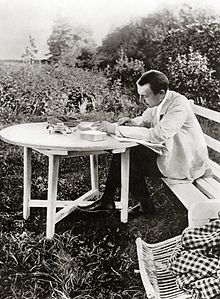
Sergei Rachmaninoff proofing
 Concerto No. 3
(Image :Public Domain)
But first an intermezzo, if you will, because this concerto teems with the most delicate little stories surrounding it, which make the music tingle with intertextuality. First composed on Rachmaninoff's family estate in Russia, Ivanovka, the piece "simply wrote itself," as he would later state. Apart from the technical and musical demands, the score for piano is actually physically demanding, with its call for swift and powerful finger work and dual octaves that continue to ring in your ears long after the last notes have faded in objective reality. The story here is that the composer himself may have had an unfair advantage playing his own work: his physiognomy suggests numerous symptoms of a genetic condition that, despite certain drawbacks, results in long, slender limbs and digits - ideal for those intimidating double octaves. What is more, his imminent move to the United States meant that after composition he had no time to actually practice the piece. At least not until he boarded the vessel to America, where he mastered it - on a dummy piano. The concerto became his "calling card" in the States, establishing him as an esteemed pianist as well as composer. 

Finale
Virtuosity is readily defined as great skill or style, but both Rachmaninoff's composition and Hough's interpretation are more than that. In the Intermezzo above, we saw the composer's suggestion that the piece "simply wrote itself". The performance was similar in that it seemed to simply play itself: in the greatest moments the soloist, orchestra and audience disappeared and the music took over, with a will unto itself. This harks back to another trait of Rachmaninoff: he often seemed to be improvising when in fact he was taking deep ownership of the work being played. The music took over. 

Are you hearing the strains of a leitmotif here? The virtuoso composer gets out of the way so the music can write itself; the virtuoso pianist eats, sleeps and hammers out the Rach 3 until it is effortless enough to play itself. In previous posts I have looked into the rousing duet between talent and expertise, as well as the overlap of "Flow" and the right hemishpere of the brain. One common theme is that vast amounts of practice are the bedrock of mastery. In the words of Michelangelo, "If people knew how long it took to gain my mastery, it wouldn't seem wonderful at all." The other is that once the skills are mastered to the point where they become automatic, that left-brain concentration can surrender to right-brain bliss. The is when the art creates itself. 

Conclusion? I would disagree with the definition of virtuosity as great skill or style. More than that: I would say that skill and style miss the point completely. Virtuosity, by my definition, is when skill and style have been polished to shine so brightly that the performer disappears and the performance takes centre stage. 

Codetta
Contemplating virtuosity a little question started to gnaw at me. It's all very well for concert pianists and composers and bearded Renaissance men with bad tempers to be virtuosos. But what about the rest of us? Somebody has to play at the very back of the second violins. Somebody has to print the sheet music. Somebody has to quarry for marble, usher patrons to the plush pink seats in which they will go numb before the third movement, serve overpriced beverages in intermission and vacuum the concert hall carpets. It certainly does take all kinds. But how many of us are encouraged to develop our virtuosity? How is virtuosity nurtuted in society?  How often do we express our virtuosity in our many realms of life constructively? There is grace and beauty in the virtuosity of so many mundane actions from very ordinary people. Even without applause, it is virtuosity nonetheless, and it is worthy of appreciation. Whether it is the trancelike glide of the seasoned barista, the reality-defying deftness of the urban taxi driver or the everyday martial artistry of the modern mother, there is a point where the performer yields the limelight to the performance. This is where the magic happens. This is the dewdrop of the spiritual realm on the earth. And it is exactly what learning is about. 

*Also Rachmaninov in certain versions

Wednesday, June 13, 2012

Studio 404: The Chronicles

Studio 404:
the inhabitant you are looking for
cannot be found
Image: mtcleroux
For those of us who live on the Web the three little digits 404 carry profound meaning. Profound and not so good. 404, for the information of those who still wander the material world, indicates an error message saying that basically, what you are looking for can not be found*. To boot, slang usage of the term has evolved to include the meaning "clueless". Hence, 404 is an apt theme (and alibi) for this post, which promotes Le Roux's Law of 404:

Cluelessness is a catalyst for learning. 

In a grand gesture of cosmic humour my humble home in Kuala Lumpur is none other than Studio 404. The name has turned out to be quite prophetic: since arriving in Malaysia seven weeks ago I have been virtually impossible to find, dashing from one place to the next in a perpetual motion pursuit of the imponderable. What's more, the transition to a new living and working environment, and the most exciting assignment of my life so far, have been the least of my concern against the backdrop of Life at large. My family's ongoing challenges continue to stir up questions that are too daunting even to try and formulate. Throw in notoriously unreliable telecommunications to Africa, explosive legacy issues in the workplace, my natural intolerance to urbanization and the local predilection for culinary neurotoxins, and things get edgy. Garnish with an attempted mugging where my sheer adrenaline-fuelled rage saved my laptop and perhaps my life last Monday night, and I feel almost justified in going 404. Cluelessness just may be okay. An optimist I may be, but to say this has been easy would be an outright lie.

So how is my cluelessness a launchpad for learning? Well, the tension between being '404' and wanting to get things right is a dynamic one. Few of us are contented with being clueless, and we want something better. Here is how I'm putting my tenure at Studio 404 to use:

Equanimity: A major learning curve has been maintaining equanimity against the backdrop of my personal life, which for all the faith and hope and love in the world is laced with a beautiful pain I have no words for. Where my usual inclination is to see the greatness and power of the individual, I have come also to see the infinitesimal, involuntary smallness of our kind. To cry my eyes out all night for someone I cannot relieve of suffering, and then get up, go to work and focus. Perhaps not optimally, but nevertheless, to go on. Life is for the living.

Common Sense Overrides the Senses: In my humble opinion one of the greatest experiences of being human is the feast of the senses. And a sense to which I am particularly partial is taste. I am almost ashamed to admit the importance I assigned to laksa when deciding to live in Malaysia: it weighed almost as heavily as the opportunity to do what I consider to be my life's work. Food - a 360 degree variety of it, served up 24 hours a day - is indeed one of Malaysia's attractions, and one I arrived committed to explore. Unfortunately most commercial foodstuffs in Malaysia are laced with monosodium glutamate (MSG), a neurotoxic flavour enhancer that reduces (or increases?) me almost instantly to a psychotic, immobile monstrosity of twice my normal size. And that's just the immediate effect: while locals do not suffer these immediate side effects, the long-term effects are clear even among younger people. I am content to consider the early warning signs a blessing and crusade for MSG-free food - woe betide the poor local chefs!

The Real Battle: My greatest teachers of the past week were two young men: motorcycle muggers who tried to steal my laptop, attacked me when I wouldn't concede and eventually fled from my unrelenting kicks and screams. These two lads ignited a controlled rage that I am learning to direct towards purposes that serve my needs. They reminded me that I can be brave and strong. And they gave me a stern reminder that rising before the sun to put your body through its paces not only makes you stronger physically and mentally, it feels incredibly good as well. But most of all, they made me ask the very important question, whether I am in the right place at all. How can I possibly thank them for doing me such a great favour?

404? That's me. But I am learning.

*One explanation why geek existentialism is a tautology that can more or less be taken for granted.

Monday, May 28, 2012

MELTA Conference 2012

MELTA publication ICT and ELT:
 Research and Practices in South East Asia
launched at the event. Image: MELTA
The past two days I have been fortunate enough to attend the Malaysian English Language Teachers' Association (MELTA) Conference in Kuala Lumpur. The theme of this year's conference is Reframing English Language Education: New Environments, New Needs, New Solutions. Working in the English Language Teaching (ELT) field in Malaysia this is an excellent snapshot of the state of our art in the nation, and having been in the country for only a month it is most timely for me personally. I must admit that on the whole I have been impressed with the dedication shown by teachers working in schools under great pressure, who have taken the time to attend. Most definitely their efforts will be rewarded with fresh inspiration and insight when they return to their schools after the event. 

In the coming paragraphs I offer a very brief review of the first few sessions of the event that I was able to attend. My more detailed notes (though a bit rough) can be found here, for those who can stomach long, long bullet lists - or would like to know about the remaining sessions. 

Royal Lecture and Official Opening
The event was officially opened by Her Royal Highness Princess Zarith Sophia binti Almarhum Sultan Idris Shah, the Royal Patron of MELTA. Following the pomp and ceremony (cavalcade, red carpet and guard of honour) it was disarming to hear that though the Princess followed up her Malaysian schooling with higher education at Oxford University and is an active patron of various projects and charities, she makes an effort to connect with the people through her regular newspaper columns, and even makes time for a round of Angry Birds now and again. In her lecture she very frankly addressed the importance of ensuring high standards of English among all Malaysian school leavers, illustrating with colourful reports from the media. Malaysia's bold future ambitions make English proficiency a key requirement, and a range of initiatives are supporting development in the language. The work of MELTA and its members in this regard was warmly acknowledged. Finally, Princess Zarith's recommendations for fostering English development included diverse learning strategies from field trips to music and drama, fostering creativity and love of the language among Malaysia's learners. 

Keynote Address
His Excellency Dato' Khayr Bin Mohamed Yusuf, Deputy Director General of Education in Malaysia, presented the keynote address, where he stressed the relevance of the conference theme. Not only should linguistic knowledge be developed in the language class, he argued, but learners should also build their abilities and independence, placing learning in the framework of learner identity and society, both locally and globally. The vital role of teachers in Malaysia's history was also pointed out (with implied reference to the part teachers played in establishing the spirit of Merdeka that led to independence). Today, in the era of globalized social media, the innovative teacher is once again faced with a re-evaluation of values as national education is transformed through a collaborative process at all levels. Events such as the MELTA conference are the platform for a meeting of minds where teachers can engage more widely in dialogue, seeking to contribute towards addressing the challenges at hand. Teachers' commitment is of the essence, and Malaysia's English teachers were saluted. 

Forum: Transnational Perspective on Teacher Education: Evolution, Revolution or Return to the Past? 
Four panellists shared their views on the matter of English teacher education in the Malaysian system. The variety of viewpoints made for quite an interesting juxtaposition that was not without its little frictions (though these did not, perhaps, extend beyond the din in my head: an impression of neocolonialist self-flagellation assisted by Prabhu's "Inner Circle" was disconcerting). 

The first panellist, Prof. Abdulrashid Mohamed, Chairman of the Malaysian Education Deans' Council, advised that teacher education be reconsidered through a new lens with regard to seven factors. These are: recruitment, the content of teacher education, governance and quality control, research and publication, professionalism, teacher education and in-service teacher training. 

Second in line was Dr. John Macalister, Head of the School of Linguistics and Applied Languages at Victoria University of Wellington, New Zealand, where a select handful of Malaysia's teacher trainees prepare for their careers. As an admitted stakeholder in the import/export of languages/skills, this speaker's presentation was naturally geared towards promoting the arrangement. (Let the record show that I am not a zealous supporter of sending teachers abroad for their entire training for a range of reasons, some of which local educators raised very eloquently during the Q&A session. As to the muddy water analogy it is best I keep my peace like a good little third worlder: I sincerely hope I misunderstood.)

Dr. Raja Mazuin binti Raja Abdul Aziz, from the Institutes of Teacher Education's International Language Campus, provided a dignified counterpoint, offering the case of local teacher education as evidence. She placed the current teacher training curriculum within the perspective of national education policy, demonstrating genuine zeal to nurture the best in the country's teachers on home soil. 

The final drumroll came from Dr. Ruanni Tupas of the National University of Singapore, who made an admirable case for the involvement of local teachers as facilitators in curriculum and materials development through grounded research. A report on a major research project across Asian nations served as evidence, and made a strong case for the self-reliance and ownership of ELT processes. It was good to hear a sense of genuine confidence in local teachers as masters of their art. 

That's as much as I have space for here, but my complete notes are available - as notes, I promise nothing more - here. On the whole it was an enlightening conference, and a few highlights made it more than worthwhile. My absolute favourite session will be covered with the detail it deserves in a later post. MELTA members went to great lengths to ensure a successful event, and I thank every one of them. I was especially impressed with the promotion of MELTA's social responsibility project at the conference, and the stellar commitment of the volunteers. Also, MELTA publications are extending their reach with the new MELTA-USM ELT in South East Asia Series. The first edition in the series, ELT and ICT: Research and Practices in South East Asia (see image, above), was launched at the conference. Naturally I look forward to learning from authors in the region and sharing a review of the volume in a later post. The sparks of new ideas were also there, and I am grateful to have shared these with ELT colleagues from around Malaysia and, indeed, the world.

Areas for improvement? I believe the event would benefit from (1) scheduling all sessions addressing certain themes in the same room. This would reduce traffic, improve punctuality and prevent simultaneous "double-booked" sessions from the same interest area, (2) inviting presenters to send their audiovisual materials for uploading and testing at least one working day before the event to prevent technology delays and angst, (3) providing more support for presenters during the session, especially with regard to timekeeping and (4) scheduling staggered lunch and tea breaks to reduce crowding. These simple steps would, in my humble opinion, go a long way towards enhancing the impression participants - and especially visitors - have of this very worthwhile event. Meanwhile, I applaud all those who made MELTA 2012 happen and look forward to great new things in future. 

Tuesday, May 22, 2012

Communicative Language Teaching: A Fruitful Revisiting

Language education can be a demanding business. So much so that when the mirage of The Perfect Method glimmers on a distant horizon, it is often embraced. More than that: in the history of language teaching the arrival of a new method has, time and again, heralded the outright rejection of All That Went Before. And so it was when Communicative Language Teaching (CLT) rose from the giddy technicolor swirl of the late seventies. CLT certainly opened minds to thrilling new avenues in language learning (or acquisition, as the debate would have it). The trouble was the religious zeal with which it was followed (not to mention the sectarian differences of interpretation). 

Prof. William Littlewood at Universiti Malaya
(Image: mtcleroux)
Today it was my pleasure to have a ringside seat to a revisiting of CLT by one of its early proponents, Professor William Littlewood, at University Malaya. (A colleague introduced him to me as someone who had written the book (see References, below), as opposed to a book, on the subject.) What made a particular impression on me was the speaker's perspicacity in allowing his views to evolve - an all too rare gem in academic circles. Entitled Communicative Language Teaching: Where are we now? Where do we go from here?, the presentation gave a useful roundup of the past, present and future of CLT. Below is my very brief (and admittedly somewhat coloured-in) summary of the talk. Any inaccuracies are strictly my own. My less colourful summary can be found here. For the more zealous, the official full text from a previous presentation on the subject is also available elsewhere. Alongside the references, a few links to papers are included here. Please note that these are from around the World Wide Wild West and included strictly as reference rather than as authorized sources.

Where have we come from? 
Communicative Language Teaching, like many a Big Idea, was born with an identity crisis. The abandon with which the idea was embraced led early on to a multiplicity of definitions ranging from hazy to outright contradictory, but congregated around the central hub of language as a means of communication - "or something like that", many in the profession would admit. Agreement existed on one point: CLT Was Good - and this was readily taken as a blanket declaration around the world. Task-Based Language Teaching (affectionately known as TBLT, which sounds remarkably like a deli sandwich to the uninitiated) is a more recent, focused subcategory. 

Although everybody seemed to follow the communicative fashion (policymakers everywhere just LOVE a silver bullet), it evolved into two streams: the "strong" and "weak" versions, which were in respectively considered more and less exalted by purists. Attention to analysis and grammar, for example, were considered "weak" and inferior. And there lies the rub. In their heart of hearts, language teachers secretly feared that their instruction was not communicative enough - yet when they followed the communicative commandments, things promptly fell apart. Something had to give. 

Where are we now? 
Reality has a wonderful way of wearing down the sharp edges of a silver bullet. The secret shame of real-world language teachers continued to simmer silently until it was revealed - and absolved - in scholarly work. This was when consideration of the context finally made a welcome return to the language classroom: principles at last took their rightful place, with methods as an expansive "palette to paint from", to quote Diane Larsen-Freeman. In this "post-method" era, it is no longer the method but the principled pedagogy that guides the way. 

Where do we go from here? 
Professor Littlewood considered four ways forward for CLT: 
1. Adapt CLT elements to local practices
2. Integrate CLT elements into traditional approaches
3. Develop a framework of 'context-free' principles for 'context-sensitive' pedagogy
4. Teachers and researchers explore key specific issues for what Littlewood calls "communication-oriented language teaching".

A useful tool (related to point 3) is the Communicative Continuum (Littlewood 2004, 2011), where activities can be placed on a scale of varying communicative qualities. This can place teaching activities in perspective of principles, context and communicative value. The Macrostrategies suggested by Kumaruvadivelu (2003) can also be of benefit, as can Prabhu's concept of "plausibility" (1990).

Conclusion
What struck me about all this was how many teachers, and how many trainers, even, were reared under rigid CLT dogma and have not yet been unshackled from it by information like this. Indeed, undiluted CLT is still the last word in that realm of ELT where citizenship of an English-speaking country and an online TEFL certificate are the sole job requirements. An important reason for writing this post, and passing on the word, is to ensure that language teachers, specifically in ELT, can be liberated from the outdated prescriptions that haunt them. It is time for teachers to emerge into the sunlight of valuing principles, context, their learners and themselves as teachers. Methods are servants, not masters. 

Kumaravadivelu, B. 2003. Beyond methods: macrostrategies for language teaching. New Haven: Yale University Press.
Littlewood, W. 1981. Communicative language teaching: an introduction. Cambridge: Cambridge University Press.
Littlewood, W. 2004. The task-based approach: some questions and suggestions. In: ELT Journal, Vol. 58/4, p. 319-324.
Littlewood, W. 2011. Communicative language teaching: an expanding concept for a changing world. In: Hinkel, E. (Ed.) Handbook of Research in Language Teaching, Vol. 2. New York: Routledge.
Prabhu, N.S. 1990. There is no best method- why?  In: TESOL Quarterly, Vol 24/2, p. 161-176. 

Wednesday, May 9, 2012

Learning a Language? The Play's The Thing!

In language teaching theory we just love the potential of the arts for enhancing learning. In practice this is not always possible on a large scale. This is why it is such a triumph to see an arts project optimised for language learning. 

I applaud the students and guiding faculty at the Institute for Foreign Languages (IPBA), Kuala Lumpur, for their production of Shakespeare's King Lear, which I was lucky enough to catch a quick glimpse of this afternoon. As a newcomer (my workplace is on the Institute's campus) I was not privy to the process leading up to the big day, but the product was impressive, not only from a pedagogical point of view but also as a performance in its own right. Three things in particular struck me about the production, and they are briefly discussed below. 

Image: IPBA
1. Optimised Language Learning Opportunities
The fabulous spectrum of language learning opportunities in a theatrical production was exploited in the production. This is especially relevant, since the troupe consisted of language learners who are training to be language teachers. Most certainly, this experience will influence their teaching profoundly, more so since it was a resounding success. Aside from the production seen on stage, students were involved in creating the programme, ushering, orchestrating the whole event and also hosting an exhibition displaying their extensive preparations, including extensive research on the play and preparation of costumes and props.

2. Learner Involvement 
The involvement and intensive, efficient, on-task team work among students seriously blew me away. From the exhibition team to the ushers and stage hands, not to mention the actors, the cooperation was staggering. Talk about learner independence - the proof of how good a job the faculty in charge did is in the fact that I have no idea who they are: the students did everything. The best kind of teaching (if we can even call it that) is when the teacher becomes invisible and the learning takes centre stage. Pun unintended. 

3. Shakespeare As You Like It
Shakespeare's venerable place in the literary canon has unfortunately given the Bard a bad reputation in English-speaking countries. Especially the tragedies are tolerated rather than enjoyed by the audience. Not so in Malaysia-Upon-Avon. If ever there was a contemporary audience to rival the ribald throng of the original Globe Theatre, this was it. The audience was enthralled, lapping up every punchline from the Jester (and every remotely risque word) with vociferous gusto. Every impressive piece of stagecraft was applauded and cheered. No stoic theatre crowd, this. This was Shakespeare as his work was meant to be performed: ribald and raucous and bustling. 

I offer a standing ovation to a good production, a great language learning project and an unforgettable teacher training experience. 

Tuesday, April 24, 2012

Disorientation and the Gentle Art of Learning

Over the last few jam-packed days of settling in for my new contract in Malaysia, I have been intensely aware of the learning curve required by new environments. Take us out of our comfort zones and we are forced to learn. Part excitement, part ecstasy, part danger and part potential frustration, disorientation is the perfect opportunity to re-examine old assumptions, explore new possibilities and discard what is, in the new context, irrelevant. 

The disorientation of any new undertaking is a steep and stimulating learning curve. Geographic disorientation is especially exciting, because it can involve new scenery, climate, culture, cuisine and all those lovely perks of travel. Even if it is only on a trip to the other side of town. (And especially if it happens to be the "wrong" side of town!)

Neurologically, this disorientation is a wonderful workout for the brain as it rolls into a higher gear, rewarding itself with celebratory endorphin spritzes with each little triumph. The more complex the disorientation, the greater the potential stress - and rewards. The increased potential stress/rewards of moving to the capital of a new country while starting a new work project is especially, er, stimulating. 

I am all for embracing the bounty offered by a new environment. In a place like Kuala Lumpur it is all too easy to speak only English, move in only cosmopolitan environments, eat only Western food, deal only with other foreigners, drive around in secluded metal cocoons and visit only seated, flush toilets with dry floors. In which case there is little point to leaving home. The gift of a different location is its differences, and in the rest of this post I am celebrating a few of these with a slideshow of photographs taken over the past few days. These include all kinds of everyday oddities, from the prosaic to the sublime. The slideshow displays below, but if you are wracking your brains to work out what is happening in the pictures, feel free to read the captions here.


In a later post I will be writing more about unlocking the basics of a new language in a new location, with my experiences with Bahasa Malaysia as example. I'll have to learn a bit more first, though! 

Friday, April 20, 2012

Sabbatical Review

I am sitting next to a packed suitcase, my online boarding pass freshly printed and foreign expert visa at the ready. Yes, I am on the road again, at least for a while. As my sabbatical comes to an end, I dedicate this post to looking back on what it brought. 
Life Plan Collage by mtcleroux, 2010

The Plan
Before embarking on my sabbatical in July 2011 I went to great lengths to justify what some would call a ridiculously long holiday. To be brutally honest, though I had an itinerary and a few courses lined up, the only real plan I had was:

Re-Evaluate My Purpose and Identity, Personally and Professionally

As later blog posts show, the itinerary and courses did not pan out, but the plan certainly did. More than I could have wished for or strategized myself. 

The Reality
Two weeks before departing for India, I received word that my grandfather had had a severe stroke. That was when my itinerary changed and my sabbatical truly began. For the next five months I went to live with my grandparents, supporting my grandfather's needs as well as managing a large household until things returned to a (different kind of) normal. 

With everything settled by mid-December, I was preparing to head abroad on a new contract when my brother sustained severe lung and brain injuries in a vehicle accident. Again, plans changed and I stayed with the family as he dipped in and out of a coma. After four uncertain months he surpassed expectations when he started sitting up and looking around curiously. He is now undergoing intensive rehabilitation to recover independent functioning, and making a remarkable recovery to the best of his old self. 

The Results
Despite its connotations, the key goal of a sabbatical is to provide a restorative and enriching time of growth. Contrary to expectations (mine, at least), my sabbatical was neither relaxing nor professionally productive. Yet restorative and enriching it certainly was, despite the major stresses that precipitated its course. As an experiment in lifelong learning, the past nine months have been extremely well spent.

What was it that I learned in nine months outside my normal profession? For the sake of convenience I  will follow the life categories suggested by author Dr. John F. Demartini in his book The Breakthrough Experience.  Here we go. 

Spiritual
My spiritual views are deep and strong and fundamentally unswerving. However, the comfort zones of my life have not often put them to the test - certainly not at breaking point. Point-blank confrontation with the life-death tightrope is the ultimate opportunity to walk the talk. The strength of my convictions has been a lifeline. An important shift is that where I used to feel I was on a lonely path, I now know that though I'm certainly not on the organized religion highway, I am not alone. 

Mental
As an intellectual/academic/professional exercise I can't boast much about my sabbatical. However, the mental realms do offer other challenges. One is that of everyday problem-solving. Managing a large household with a frail resident over the past months, my problem-solving muscles have started bulging. Among the many "menial" tasks I have done, I suspect my most important contribution was streamlining inefficiencies and basically making things better for our patients, residents and staff. Another mental challenge is that of controlling the mind when faced with adversity. Under the circumstances, of course there have been dark days, but on the whole I have sustained a constructive (if not always sunnily positive) outlook. This is not a matter of temperament (certainly not in my case!) but of discipline. 

Vocational
To me there is no such thing as a job. There is only a vocation, and this is always far bigger than one's job and even one's career. Vocational clarity was at the core of my sabbatical quest. Though circumstances elbowed this out to the periphery of my awareness, the step away from my professional focus has turned out to improve my vision and is concluding my professional retreat with a veritable fireworks display. Much of the time I felt professionally paralyzed by the constant stresses and demands on my time from my environment, not to mention the perpetually closed doors of the job market in my home country. In time, though, the good did come. 

After my brother's accident I was adamant to establish a local professional practice that would allow me to stay near my family while he recovers. The result is The Living Learning Group, a small educational consultancy based in Pretoria East specializing in educational training and English as a Second Language (ESL) support. This will remain my local professional base for future projects. Meanwhile a phenomenal opportunity to assist with teacher training came my way from a foreign Ministry of Education (more about that later). As a short-term contract, this will be my first major project, equipping me with better expertise when I return to do the same in South Africa. At that point, the impact of having worked with two brain patients will also play a large part in my future work. In short, stepping away from my job was the best possible thing I could do for my vocation. 

Financial
For most of us mere mortals, there is a small catch to taking time off work: No Work, No Pay. After six years of supposed hardship postings in the Middle East, I have been blessed with the opportunity (not always seized, I admit) to build up some savings. I had planned for a comfortable six month sabbatical, and came in marginally over budget. The additional months did make a dent, but I am grateful to say that thanks to moderately good planning and free room and board from the family am still well afloat. 

The financial virtue of taking time off without pay is that it forced me to be a bit more meticulous about my budget and planning. Family administration problems also encouraged me to set up detailed records of every aspect of my finances, a last will and testament, living will and insurance policies for my specific needs. I even made a substantial investment in bonds and started a new savings investment. On the whole, I feel considerably more financially secure than ever before, even despite having been without an income for three quarters of a year. And grateful to be in this position! Deeply grateful!

Familial
One of the reasons why I have never seriously considered starting a family is the responsibility involved. Well, apparently I was not meant to dodge those responsibilities. I have lived alone almost half my life now, mostly in foreign countries, and living with family was a major adjustment. Looking at my packed suitcases and the prospect of my own little singleton home again, I have mixed feelings. I like being in charge of my own habitat, I really do. But I will miss waking up before dawn and taking my mom coffee in bed, only to sit there chatting for an hour. Having people to cook for (another skill I have been building over the past months). Having a truly loving and supportive environment. Through no fault of my parents, my childhood was not not an easy one. These past months of urgency have mended many old wounds, and this has been one of the great gifts of an apparent adversity. My heart has always been open to anonymous humanity, but this past time has opened it to my own family. It is the first time that I am going abroad rather than fleeing, and that says a great deal. 

Social
The demands of my sabbatical time have made a "normal social life" roughly impossible. People my age are generally looking after the next generation rather than the former, while the few die-hard singles are either partying or working too hard to bother. Then again, as a long-time expatriate a "normal social life" has rarely been on my agenda. Still, people interaction has played a very important part in my time here. Managing the household there have been key relationships to nurture - some with my elders, who can be set in their ways to say the least, some with staff, whose role in a large house with two elderly residents is crucial, and many with the public. I have truly felt under grace as my understanding of nurturing relationships has grown. I have made mistakes: a few hefty but short-lived skirmishes, several instances of helping too much and being too nice (a common vice of mine), but I trust my learning far outweighs my failures in this department. 

Physical
I cannot over-emphasize how important my physical wellbeing is to every other aspect of my life, and the past months have been a case in point. Naturally, this is even more crucial in times of great stress. I started the sabbatical period yielding to social demands, which often involve delicious food with disastrous consequences. The more I stood my ground and ensured that healthy food was always available to share, the better I felt physically, mentally and emotionally. Others also benefited from better nutritional habits. Not only that, but sound self-care became self-sustaining and even, believe it or not, addictive. Over the past weeks I have had most of my exercise from running around to prepare for this sudden trip, but I would like to incorporate more regular, enjoyable and especially outdoors exercise into my days and return to a brief morning yoga routine which has somehow fallen by the wayside. On the whole, though, physically this has been a productive time. 

Conclusion
Was my sabbatical a success? Well, it was not in any way what I expected it to be. Looking back, though, this has been a pivotal point in my life, especially with respect to vocation. I am extremely grateful that I had the opportunity to take the time off, awed that departing from my itinerary would set such a miraculous course and deeply restored to take on new challenges. It is an experience I would recommend to anyone who has the opportunity - and even more so to those who can create the opportunity. That alone is a noteworthy accomplishment.