Allegro ma non tanto
I just got back from a performance of Rachmaninoff's* notorious Piano Concerto No. 3, with soloist Stephen Hough supported by the Malaysian Philharmonic Orchestra. Notorious, because "The Rach 3", as it is known with shuddering affection by those in the know, is considered among the most demanding piano concertos in the classical realm. Watching Hough soothe, coax and attack the instrument in turns this evening with this fearsome reputation of the piece at the back of my mind, I couldn't help but think that he made it look so easy. And that is why this post is devoted to the subject of virtuosity.
Intermezzo
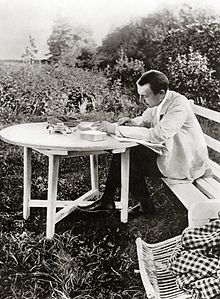 |
| Sergei Rachmaninoff proofing Concerto No. 3 (Image :Public Domain) |
But first an intermezzo, if you will, because this concerto teems with the most delicate little stories surrounding it, which make the music tingle with intertextuality. First composed on Rachmaninoff's family estate in Russia, Ivanovka, the piece "simply wrote itself," as he would later state. Apart from the technical and musical demands, the score for piano is actually physically demanding, with its call for swift and powerful finger work and dual octaves that continue to ring in your ears long after the last notes have faded in objective reality. The story here is that the composer himself may have had an unfair advantage playing his own work: his physiognomy suggests numerous symptoms of a genetic condition that, despite certain drawbacks, results in long, slender limbs and digits - ideal for those intimidating double octaves. What is more, his imminent move to the United States meant that after composition he had no time to actually practice the piece. At least not until he boarded the vessel to America, where he mastered it - on a dummy piano. The concerto became his "calling card" in the States, establishing him as an esteemed pianist as well as composer.
Finale
Virtuosity is readily defined as great skill or style, but both Rachmaninoff's composition and Hough's interpretation are more than that. In the Intermezzo above, we saw the composer's suggestion that the piece "simply wrote itself". The performance was similar in that it seemed to simply play itself: in the greatest moments the soloist, orchestra and audience disappeared and the music took over, with a will unto itself. This harks back to another trait of Rachmaninoff: he often seemed to be improvising when in fact he was taking deep ownership of the work being played. The music took over.
Are you hearing the strains of a leitmotif here? The virtuoso composer gets out of the way so the music can write itself; the virtuoso pianist eats, sleeps and hammers out the Rach 3 until it is effortless enough to play itself. In previous posts I have looked into the rousing duet between talent and expertise, as well as the overlap of "Flow" and the right hemishpere of the brain. One common theme is that vast amounts of practice are the bedrock of mastery. In the words of Michelangelo, "If people knew how long it took to gain my mastery, it wouldn't seem wonderful at all." The other is that once the skills are mastered to the point where they become automatic, that left-brain concentration can surrender to right-brain bliss. The is when the art creates itself.
Conclusion? I would disagree with the definition of virtuosity as great skill or style. More than that: I would say that skill and style miss the point completely. Virtuosity, by my definition, is when skill and style have been polished to shine so brightly that the performer disappears and the performance takes centre stage.
Codetta
Contemplating virtuosity a little question started to gnaw at me. It's all very well for concert pianists and composers and bearded Renaissance men with bad tempers to be virtuosos. But what about the rest of us? Somebody has to play at the very back of the second violins. Somebody has to print the sheet music. Somebody has to quarry for marble, usher patrons to the plush pink seats in which they will go numb before the third movement, serve overpriced beverages in intermission and vacuum the concert hall carpets. It certainly does take all kinds. But how many of us are encouraged to develop our virtuosity? How is virtuosity nurtuted in society? How often do we express our virtuosity in our many realms of life constructively? There is grace and beauty in the virtuosity of so many mundane actions from very ordinary people. Even without applause, it is virtuosity nonetheless, and it is worthy of appreciation. Whether it is the trancelike glide of the seasoned barista, the reality-defying deftness of the urban taxi driver or the everyday martial artistry of the modern mother, there is a point where the performer yields the limelight to the performance. This is where the magic happens. This is the dewdrop of the spiritual realm on the earth. And it is exactly what learning is about.
*Also Rachmaninov in certain versions

